


BOSTON MARATHON 2026
Notes about the race by Dave Kayser
The Boston Marathon enlivens the host city like few other large city marathons can. Media coverage abounds, retailers offer race specials, restaurants have marathon-themed meals, hotels welcome the participant’s open wallets, street banners are hung along main thoroughfares and good-natured crowds all make for an exciting weekend to ramble through the city and feel civic pride.
The Bank of America Boston Marathon Expo at the Hynes Convention Center was an upgrade over previous years, with race sponsors making concerted attempts to have eye-catching exhibits. The Bank of America space had a ‘Make Way For Ducklings’ photo op with unicorn heads taking the place of ducklings. Cowbells were given away and tables were set up to make cheer signs. The space they occupied was spacious and airy, as befits a presenting sponsor.
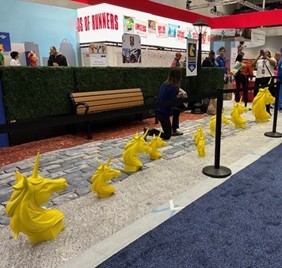
Line of unicorn heads plays on an old children’s story, ‘Make Way for Ducklings’ set in Boston where a row of ducklings follows their mom across city streets.
The emerald green-toned Schneider Electric Energy Zone Experience Tunnel proved to be a delight for children to run through and the same went for a contest to see who could fully charge a ‘battery’ the fastest by stomping on a plexiglass panel.
The Boston Athletic Association (B.A.A.) put together an exhibit in the form of two rows of gym lockers, with each locker given over to a race notable that included memorabilia, photos and information on each individual. (Following page.)
Featured among the 12 individuals were Bobbi Gibb, the first female finisher 60 years ago, Jack Fultz, honored for the 50th anniversary of his win and Rob De Castella’s 40th. Fultz served as the race’s grand marshal this year.
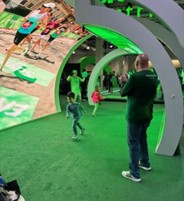
The Schneider Electric Energy Zone Experience Tunnel was a hit with kids.
One of the unexpected highlights of the expo was ultrarunner Ashley Paulson’s attempt to break the women’s 100 mile treadmill record at the NordicTrack booth. Starting in the wee hours of the morning with just her husband and timers in attendance, she began ticking off the miles and quickly grew an enthusiastic and appreciative crowd when the expo opened at 9 a.m. Spontaneous applause occurred often and cheers erupted as each mile was completed. She accomplished her goal at 4:30 p.m., breaking the existing record by nearly an hour and a half.
Panel discussions were held throughout the three day event, with numerous professional and notable runners participating. During session breaks many runners climbed on to the speaker stage to have their photo taken in front of the large Boston Marathon logo backdrop. A succinct and well-written race day information panel that answered frequently asked questions was studied by many. The most popular photo op by far was a mock-up of an oversize finisher’s medal and the adjacent adidas store, packed with both branded merchandise and runners, was nearly as large as the main expo space.
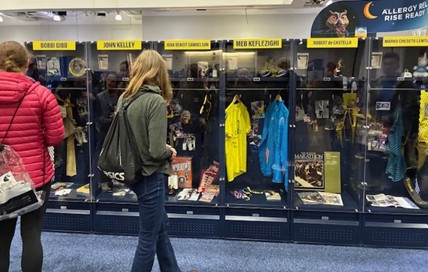
Memorabilia of the champions of yesteryear reflect how deeply the Boston Marathon is steeped in tradition.
On nearby Newbury Street, the excitement was not consistent with levels achieved in previous years, perhaps due to the chilly and windy weather conditions. Numerous shakedown runs sponsored by footwear and other companies took place on both Saturday and Sunday mornings. The most popular attraction was the Tracksmith store, where a line of customers snaked down the sidewalk waiting to get in. One out-of-the-ordinary shop was populated by five women-led businesses, led by Swift Running, who are in the initial stages of producing affordable carbon plated running shoes. The other establishments in attendance were jewelry purveyor Twenty Six Diamonds, Pen + Pacers, Race Day Rangers, who market a large array of race patches and Running Peas, who sell running clothes for kids. The set-up was street savvy and very inviting. It was a nice change of pace from many of the slick shops along the upscale street.
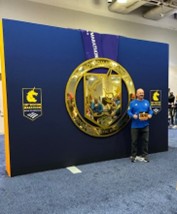
Very popular photo op with a very shiny object: gargantuan finisher’s medal
Runners were well treated at many restaurants in the vicinity. A complimentary order of wings or tenders at Rocco’s Sports & Rec could be had by showing a race bib in the days leading up to the race, and the South Street Diner had an all day, all-you-can-eat pancake feast for $10 on Sunday. Unlimited pasta could be consumed at Bosse Enoteca the day before the race and a free meal could be enjoyed at Banners Kitchen and Tap after the race by showing off a finisher’s medal. The Seaport area had numerous giveaways and discounts for runners.
The Fairmont Copley Hotel, which served as race central, emblazoned their elevator doors with the Boston Athletic Association’s unicorn logo and their house dog proudly wore a B.A.A. neckerchief throughout the weekend.
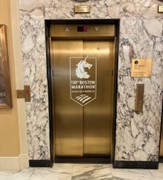
The Fairmont Copley Plaza Hotel cemented its status as race central by transforming elevator doors
The Independent reported the Boston Athletic Association procured the services of Marcel Altenburg, a crowd scientist at the Manchester Metropolitan University in England to examine all manner of race operations. Altenburg ran more than 100 race simulations, testing the effects of a varying number of runners, more start waves, different weather conditions, finish line configurations and anything else he could imagine, all with the aim to improve the running experience. Both the organizers and Altenburg were cognizant of the historic aspects of the race, and before any adjustments were made, “we really make sure that if we change something about this historic race, then we know what we’re doing.” In the end, Altenburg recommended increasing the number of start waves from four to six, along with adjustments to the unloading of buses at the start, the placement of aid and water stations along the course, finish line chute configuration and the finisher medal pick up area.
Almost all the seats were occupied in the media work room at the Copley Plaza Hotel on race day. The temperature in the room approximated the chilly outside conditions, allowing those in attendance to identify closely with the runners. The speaker system delivered clear and sharp sound and race updates by B.A.A. staff were brief, pertinent and timely.
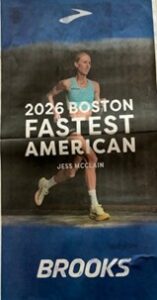
Full page ad for Brooks appeared in the Boston Globe the day after the race
The Boston Globe provided extensive race coverage both before and after the Monday event. On the day before the race, there were articles on American chances to climb onto the podium and an analysis of the expansion of start waves, a topic that would rarely, if ever, be covered by a mass market newspaper. A long profile on running podcaster and race announcer Ali Feller detailed the recent health challenges she has faced. The Sports section was nestled inside a four page On Running ad publicizing their innovative Cloudspray shoe that was available for the first time at their Newbury Street store. The paper also had an eight page special section titled ‘Puzzle Marathon.’ The 26 puzzles, including crosswords, sudoku, word association, pun solving and anagrams, became more difficult as the player went through each one.
The day after the race, the paper had lead stories on the front page of the paper and the same for the Metro and Sports sections. Numerous articles and photos covered the men’s, women’s and wheelchair races, the top Americans, lead runners in each division and fan experiences over multiple pages. Brooks ran a full page ad showing Jess McClain which simply said “2026 Boston/Fastest American” over her name. The April 26 Sunday Globe newspaper greeted readers with a four page front page insert sponsored by the Bank of America that listed each charity runner and the nonprofit they were supporting. To date, the nearly 4,000 charity runners have raised over $53 million.
Standing in the back of the media room as the race wound down, four writers were comparing notes on their relationship with the marathon. A quick tabulation came up with 200-odd years of race attendance among the four, including running in, spectating at, reporting on and riding in the lead trucks. Pondering this bit of trivia as they stared at the floor beneath them, they all came to the realization that there is nothing quite like the Boston Marathon with its extensive history, welcoming citizenry, top-notch running and many surprises.