


2026 Boston Marathon Notes
A Stream of Consciousness and Pictorial Overview of the 2026 Boston Marathon
By Phil Stewart
Pre-race: When the Boston Marathon started its charity program in 1989 with a single charity, the race was truly about the competition. As the only marathon (outside of the Olympic Trials) with qualifying times, it earned a special respect, and running it was a badge of honor for the few thousand runners who lined up on Hopkinton on the third Monday in April each year. Qualifying remains a big deal today with the letters “BQ” practically as widely known among runners as the letters “PR,” and the Boston Athletic Association (B.A.A.) still invests hundreds of thousands of dollars into prize and appearance money for some of the fastest runners in the world. But for “Presenting” sponsor Bank of America the emphasis appears to be much more about the funds raised for the official charities (AI claims over $600 million raised since the program began). The Bank of America booth at the expo was all about the fundraising with the overall theme of the booth being “What’s Your Reason to Run.” The text crawl on the large video screen
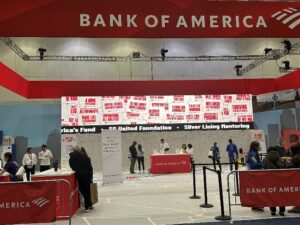
Expo in Hopkinton near start
contained the list of all of the official charities. At the starting line in Hopkinton the Bank of America kudos were all about the money raised for charity. Prior to the start in Hopkinton, this reporter did not hear the word “qualifiers” a single time and the first mention of the elites were the introductions moments before the gun. The branding theme of this year’s race was “Meet the Moment” which seems like more of a nod to the fundraisers than the qualifiers who met their moments before getting to the starting line in the first place.
Bank of America continues to increase its exposure incrementally each year as shown by two photos below comparing the finish line structure in 2024 and 2026.
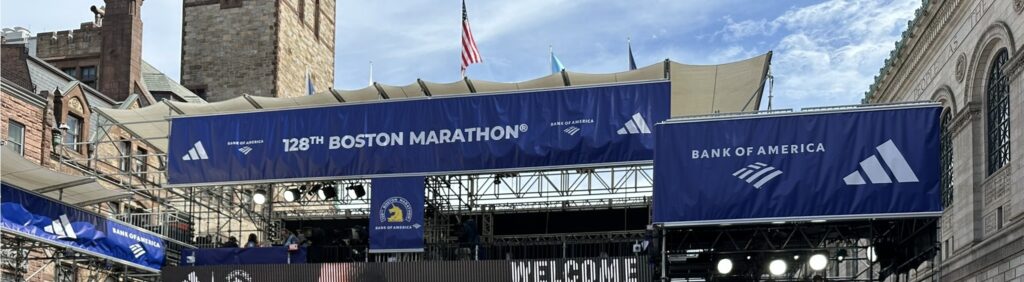
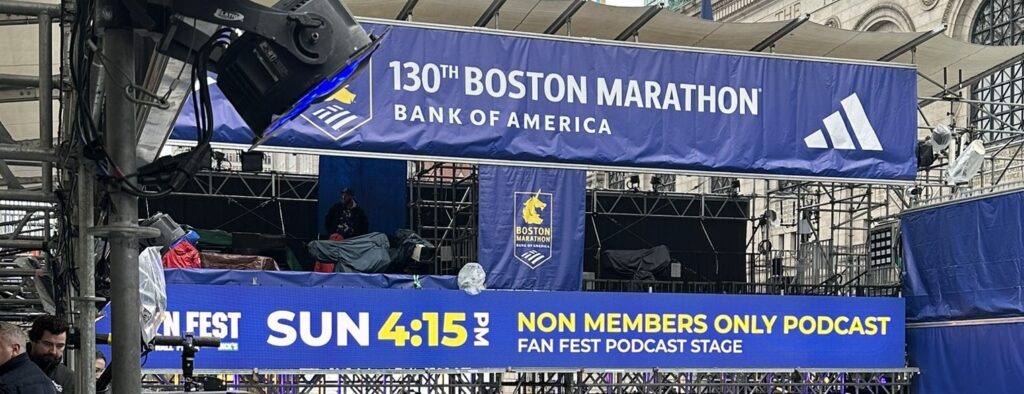
The B.A.A still retains complete control of the finish line decal on the roadway, as seen below:
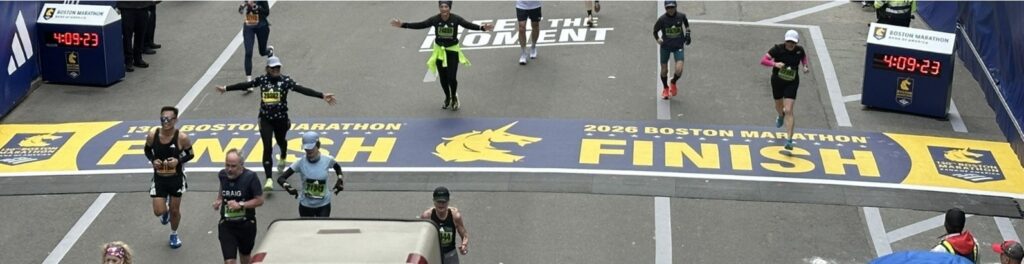
 Although adidas is the second most visible sponsor with the grand entrance into the Expo serving as an adidas Emporium and all the other exhibitors (sponsors and charities only) tucked behind the massive adidas store (left, adidas Emporium), other shoe companies are always on the lookout for ambush opportunities as shown below in three photos taken along Boylston Street where the race finishes.
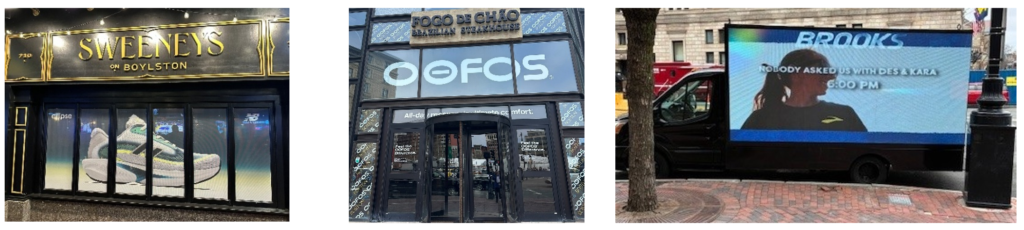
From left: “ambush” opportunities of New Balance, Oofos, and Brooks near the finish.
The Race: The biggest organizational change this year was increasing the number of starting corrals from four to six in order to reduce crowding on the course. The following flow document shoes the impact of this change with the peak densities of the six-wave start less than of the four-wave start.
The challenge was not to increase the length of time the course remained open, so the six waves started at 13-minute intervals versus the 25-minute intervals with the four-wave start. The ripple effect of the change meant re-working the timelines all the way back to the bus loading in downtown Boston for transporting the runners to Hopkinton in the wee hours of the morning.
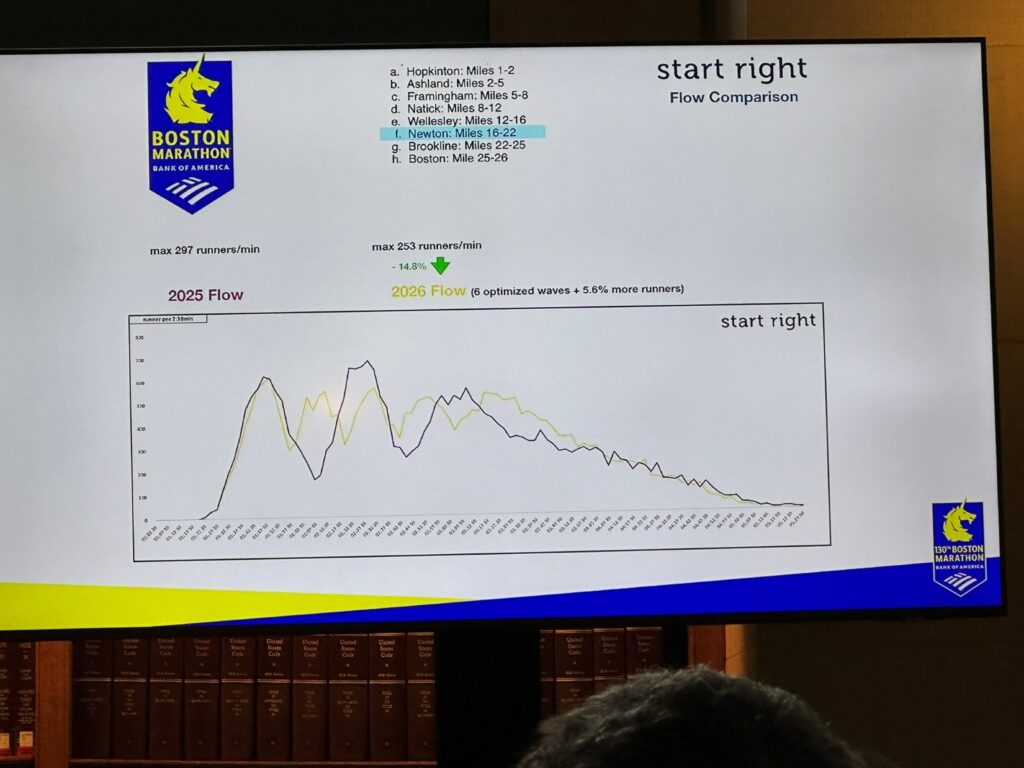
The six waves were also used for triaging the runners both before and after the race.
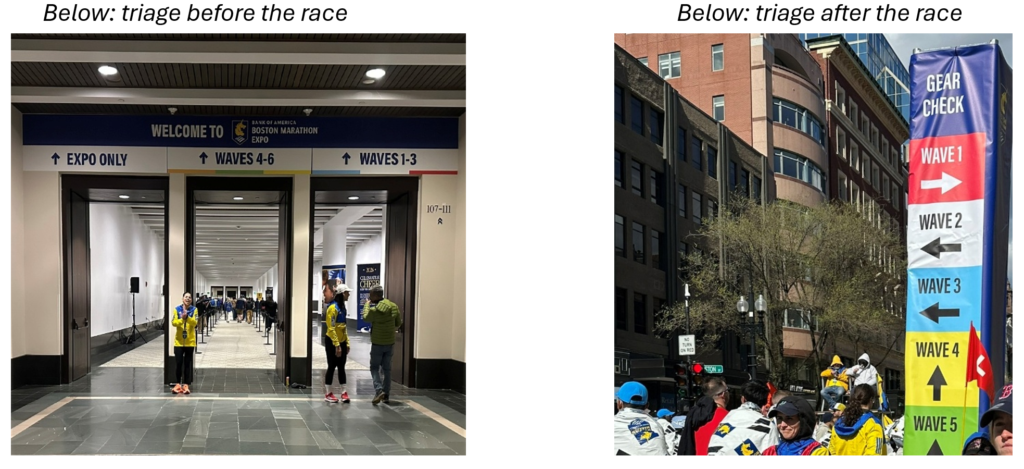
Left: triage before the race, Right: triage after the race
For years, the race has used a “human chain” in Hopkinton, a long line of volunteers to keep the elite runners confined to a limited area in front of the starting line for their warm-ups. As the starting time nears, the volunteers nudge the runners back toward the starting line. The human chain got tested this year as the elite men broke from the start early and had to be marched back into position. See below.
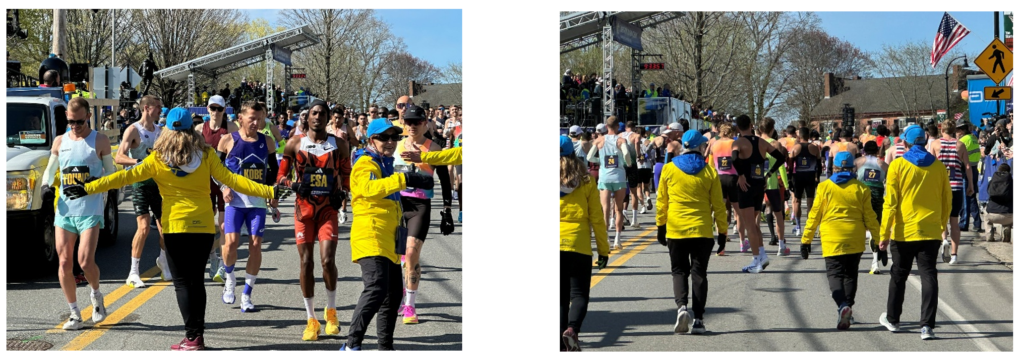
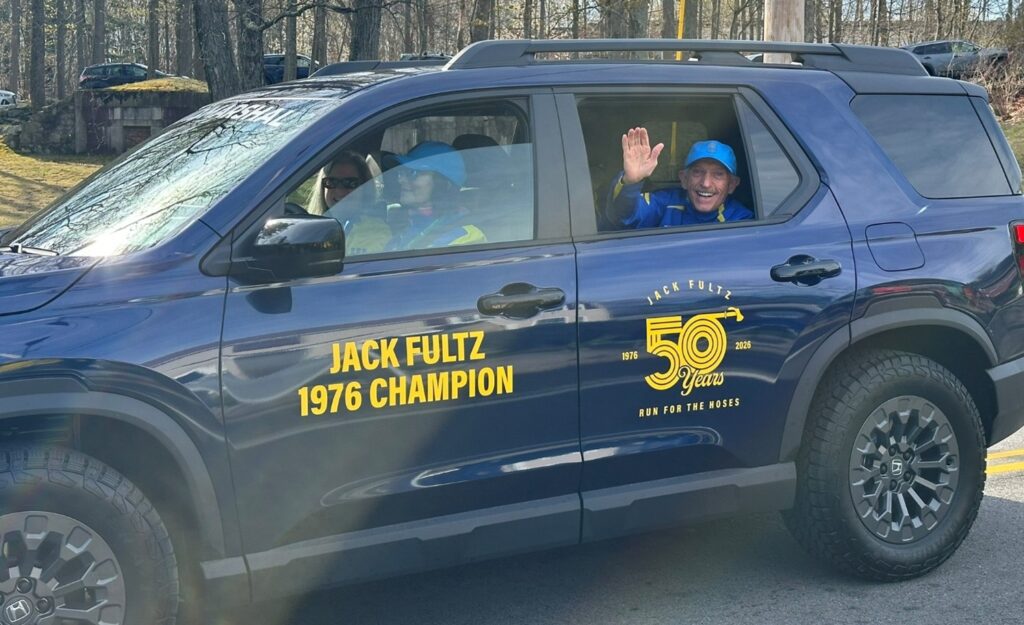
Race day was one of those days that comes along once or twice in a decade at Boston with cool temperatures and wind out of the west, which translates to a tail wind for the point-to-point course which runs from west to east. The weather in Boston in mid-April can be volatile with the race experiencing extremes from the Nor’easter in 2007—which nearly forced the event to be canceled—and high winds and sleet in 2018, to the 100-degree temperatures in 1976. This year’s race marked 50 years since that legendary race, which earned the moniker “the Run for the Hoses” and was won by Jack Fultz, who served as the Grand Marshall this year and had a far easier tour of the course. Below, Jack Fultz rides the course in a style undreamt-of when he was sweating buckets en route to victory 50 years ago.
The B.A.A. hosts an extensive number of athletes with disabilities including a large contingent of Duos who start before the elite men. In general, the Duos (below left) seemed to stay out of the way of the elite men while being overtaken. The lead pack of men was 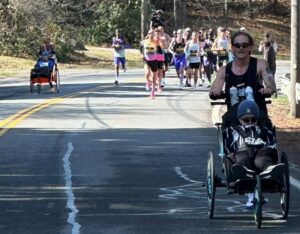 thick and good spirited through the first half of the race, covered in 1:01:42. American Clayton Young even took time to high-five the women of Wellesley as he passed through the “Scream Tunnel” at the 20K mark. Defending champion John Korir put on a textbook display about how to run the race, as he let others do the pace setting before taking the lead just before Heartbreak Hill and ran a significant negative split (1:00:10) to break Geoffrey Mutai’s 15-year-old course record of 2:03:02 by 70 seconds in 2:01:52. Second and third place Alphonce Simbu and Benson Kipruto also broke the old record, in 2:02:47 and 2:02:50, respectively.
Post-race: With the point-to-point Boston course ineligible for world record consideration, and the course punctuated by the Newton Hills earning it the reputation of being challenging, champion Korir said afterward that running a world record simply wasn’t on his mind, stating, “I did not know I would [run] this fast . . . when I found out I had the course record, I was very happy.” It was a good day for Americans as well, with Zouhair Talbi running the fastest time ever for an American in 2:03:45 and Charles Hicks lowering his PR to 2:04:35. The women’s race featured four Americans in the top 10 headlined by Jessica McClain’s fastest ever American time at Boston: 2:20:49.
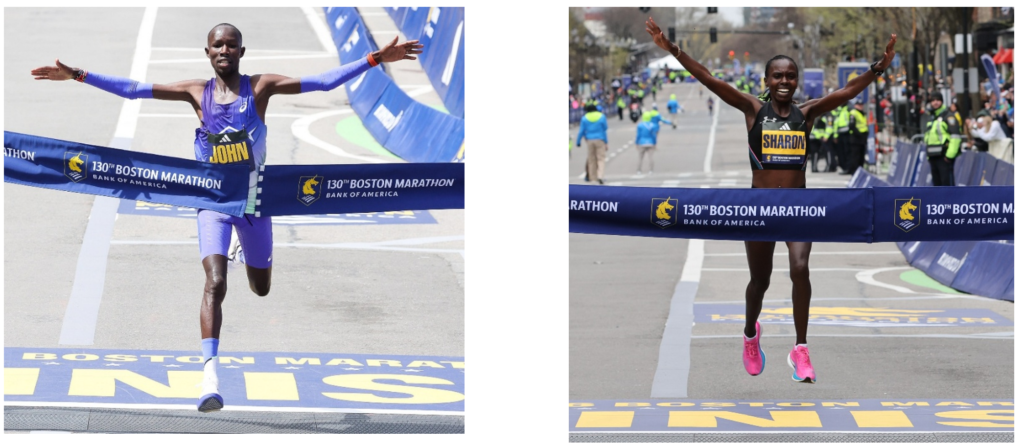
Above left: Kenyan John Korir set a course record 2:01:22 to cap a second straight Boston win //Photo: B.A.A// Above right: Sharon Lokedi repeated at Boston with the second-fastest ever woman’s time on the course: 2:18:51 //Photo: Jane Monti for Race Results Weekly//
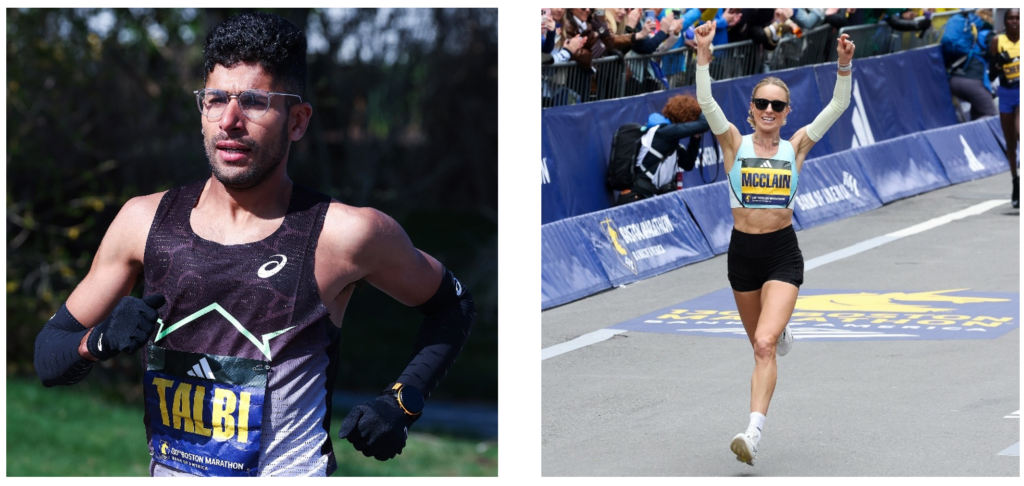
Above left: Zouhair Talbi placed fifth overall with the fastest American time ever //Photo: Phil Stewart// Above right: Jessica McClain ran the fastest ever American women’s time at Boston. //Photo: B.A.A.//
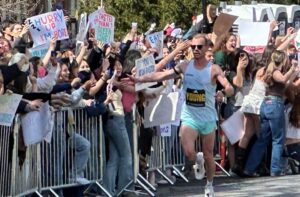 Clayton Young took advantage of a rare opportunity to get in touch with his fans. Here he is high-fiving his way through the Wellesley College “scream tunnel.” Young was the third American after Zouhair Talbi and Charles Hicks, and 11th overall in a personal best 2:05:41.
Miscellaneous: There were four organizations mentioned over the weekend which may be of interest for race directors to learn more about. Road Race Management has not explored these groups in detail but found them intriguing enough to make a note of them for our E-News readers for further exploration. A link and a bit about each company as taken from the company websites are listed below.
Everbridge: www.everbridge.com
From severe weather events to active assailants or IT disruptions, the Everbridge critical event management (CEM) platform helps you confidently anticipate and mitigate potential threats. Enabling you to know earlier, respond faster, and continuously improve, Everbridge 360 empowers you to safeguard your people and your organization.
OLA Capital: https://www.olacapital.vc/
Invests in companies working on improving quality of life. A rapidly aging population is driving unprecedented demand for interventions and strategies that not only extend lifespan, but improve overall healthspan. Crucially, as people continue to live longer than ever, there becomes a critical need for financial resilience and tools aimed at extending wealthspan. Let’s reframe this accelerating crisis into opportunity by making healthy aging and optimizing healthspan the focus.
GivenGain: https://www.givengain.com/
A company that supports charity fundraising efforts, GivenGain is a global nonprofit, backed by foundations in the USA, UK, and Switzerland. Since 2001, we’ve empowered donors and fundraising champions in 190+ countries, supporting causes in over 100.
Move United: https://moveunitedsport.org/
Move United is the national leader in community adaptive sports. Our 252 member organizations in 45 states are united by a single mission: ensuring everyone, regardless of ability, experiences the life-changing power of sport and is included in their community.
Last but not least: volunteers are indispensable to any race organization, and the 8,200 volunteers of the Boston Marathon are a major part of what makes the Boston Marathon hum.
Quick stats about the Boston Marathon Volunteer Operation
Volunteers take over post-race duties on Boylston St. Many volunteers stick around until after dark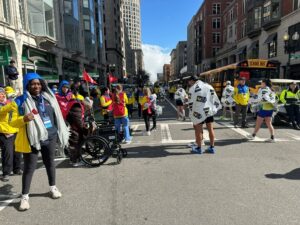
- 8,200 total volunteers
- 2,000 medical volunteers for marathon, 5K and expo
- Medical volunteers have separate registration process so credentials can be confirmed.
- 12,900 applications for 10,000 volunteer slots; maintain a wait list
- Expo: 1,500 volunteers; Start: 1,000 volunteers; Finish: 1,500 volunteers
- State of Massachusetts assigns a value of $42 per hour of volunteer labor. So Boston volunteers represent $2.5 million of labor
- Minimum volunteer age is 18
- Event relies more on volunteer groups than individuals since groups have a better show up rate. Best groups are colleges, corporations, local running clubs, local non-profits, and sponsors.
- Have a centralized volunteer check-in system.
- Volunteers who cancel in advance will be allowed to volunteer in the future. No-shows on race day are not accepted as volunteers in the future
- All volunteers get CPR training
- About 30% of volunteers complete a post-race survey
- 80 volunteers have volunteered for more than 35 years. 15-year volunteers get mentioned on website; 20 and 25 year volunteers get pins; 30-year get a medal and an invite to a luncheon; 35 years get an invite to a race weekend reception and a medallion
- Race produces volunteer videos for most positions
- Volunteers not allowed to use cell phones while on duty (except for emergencies)
All photos in this document are by Phil Stewart of Road Race Management unless otherwise specified.