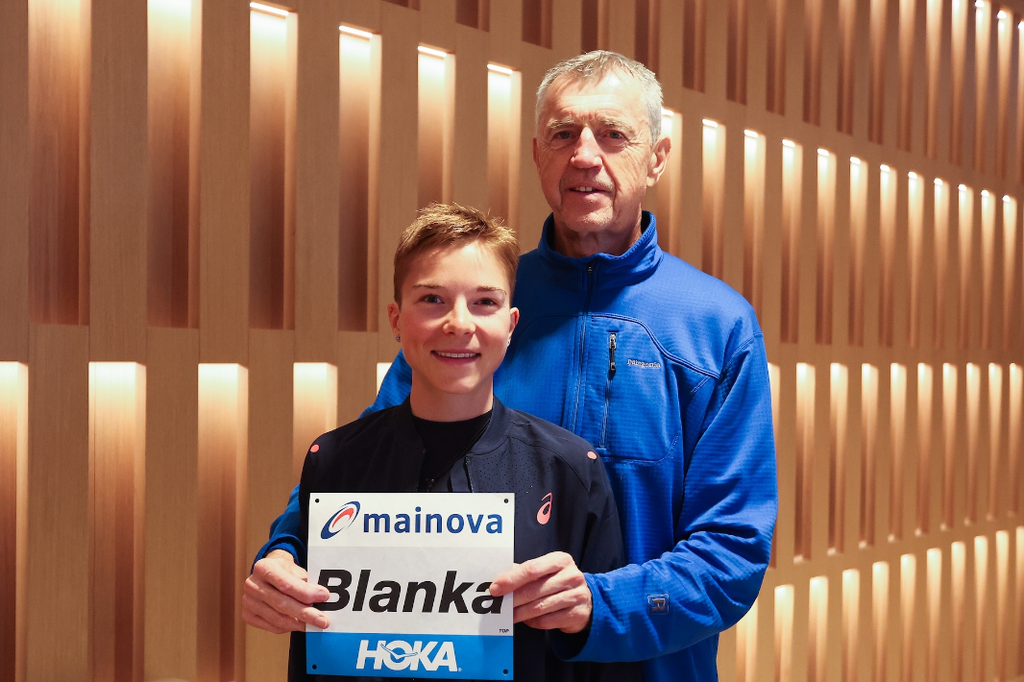
Blanka Dörfel: Another major career breakthrough in Frankfurt?
After 25 years in charge as Race Director of the Mainova Frankfurt Marathon Jo Schindler received a surprising farewell present. It was not what was originally planned. Because the poor weather conditions ruined hopes for a German or even European marathon rerecord. But so often marathon races can produce unpredictable results. That’s what happend in Frankfurt’s Festhalle on Sunday. Jo Schindler and the spectators experienced a delayed surprise. Amanal Petros, on whom hopes of a record had rested, finished runner-up in 2:05:46 after a strong race. Exactly 15 minutes later Blanka Dörfel followed and took second as well. With a time of 2:20:46 it was the 24 year-old from Berlin who made the headlines on her debut. “That was the start of a big career,” said Philipp Kopp, who is responsible for the elite fields in Frankfurt. Blanka Dörfel immediately became the second-fastest German female marathon runner of all time and the eighth-fastest in Europe.
Frankfurt has often been the launching pad for great marathon careers, which is also down to the approach taken by the race’s sporting directors. What Christoph Kopp – who passed away in 2023 – successfully introduced is now being continued by his son Philipp: Usually not the big stars are are brought in, but athletes who are tipped to make a breakthrough. In 2010 Kenya’s Wilson Kipsang ran a course record and a year later he missed the world record by just four seconds with a time of 2:03:42 in the Festhalle. Following that Kipsang went on to win in London, among other races, finished third at the Olympics (both in 2012) and broke the world record in Berlin in 2013 (2:03:23). In 2017 Shura Kitata achieved his breakthrough with a victory in Frankfurt. Three years later the Ethiopian won the London Marathon. The most recent example of major victories following a triumph in Frankfurt is Hawi Feysa. Two years ago the Ethiopian ran a course record of 2:17:25 here. She recently won the Chicago Marathon for the second time in a row and became the fourth-fastest woman of all time.
With her magnificent debut Blanka Dörfel added her name to the list of the fastest European marathon runners. German record-holder Irina Mikitenko (2:19:19 in Berlin in 2008) is the only one still ahead of Blanka Dörfel in the national rankings. The new number eight in Europe set a German leading time for 2026 and with her 2:20:46 she is the second-fastest European this year. Only Finland’s European Champion Alisa Vainio (2:20:39) was faster. Dörfel improved the unofficial German debut record by over three minutes (Melat Kejeta ran 2:23:57 in Berlin in 2019).
Furthermore Blanka Dörfel is now by far the fastest German woman in the history of the Mainova Frankfurt Marathon. This mark had previously been held by Fate Tola, who clocked 2:25:42 in 2016 when she was runner-up as well. Only two European women have clocked faster debut times than Blanka Dörfel: Sifan Hassan ran 2:18:33 in London in 2023. A year later the Dutch athlete became Olympic Champion in Paris. And in 2002 legendary British runner Paula Radcliffe began her marathon career in London with 2:18:56. She went on to break the world record and held it for 17 years.
As a junior Blanka Dörfel ran a couple of very strong times. Five years ago she clocked 71:54 in the half marathon and was the fourth fastest junior in the world in 2021. However she was unlucky when she caught Corona and then fought a series of infections following that. That set her back for a long period of around two years. Otherwise she might have run her marathon debut earlier. “I think I am borne for the marathon,“ said Blanka Dörfel, who has a half marathon PB of 68:06 from Mainz this spring.
For Blanka Dörfel Frankfurt was merely a first step, and one that should not be overrated. And hardly anyone takes such a realistic view of this major success as Dieter Hogen does. “If you want to reach world-class level, you have to run well under 2:20:00; otherwise, you are a long way off. Most runners lack the speed over the shorter distances to achieve this. Times of under 14:30 over 5,000 metres and under 30:00 for 10 k are essential,” explains the coach, who in the 1990s guided Uta Pippig and subsequently a number of Kenyan runners to spectacular marathon victories in Boston, New York, London, Chicago and Berlin.
Blanka Dörfel is in close contact with Uta Pippig. “She is a marathon icon and has a really great mindset. But I do not want to follow in anyone’s footsteps – I want to forge my own path,” says Blanka Dörfel.
“In Europe so few female runners manage to run under 2:20:00. I got close to that mark today.” The prolonged cold and wet conditions probably cost Blanka Dörfel such a result in Frankfurt. “Towards the end of the race, I had lost all feeling in my arms and hands, so I could not reach for any refreshments. My legs were cold too. But I am looking ahead – perhaps it will be warmer next time, and then I will be able to run a bit faster.”
Further information is available at: www.frankfurt-marathon.com
Please note: The attached photo showing Blanka Dörfel and her coach Dieter Hogen can only be used in association with this press release and with the following credit: Victah Sailer
Blanka-Dörfel-Dieter-HogenBib-Frankfurt26.JPG