


Reviewed by Dave Kayser
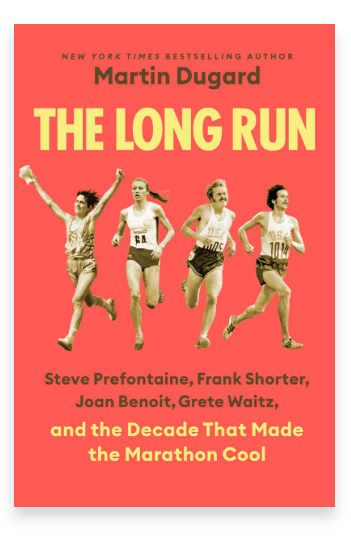
As I looked at the cover of Martin Dugard’s The Long Run for the first time, I raised an eyebrow. Subtitled Steve Prefontaine, Frank Shorter, Joan Benoit, Grete Waitz and the Decade That Made the Marathon Cool, anyone familiar with Steve Prefontaine knew he was a man of the track and never once ran a marathon during his luminescent career. How could he be considered a marathon influence? Despite the seeming inconsistency, I decided to flip through the index and saw runner’s names like Jon Anderson, Marty Cooksey, Bob Schul and non-runners such as Plutarch and Leonardo DaVinci, all names that don’t routinely get mentioned when reading or talking about the history of the marathon. I went to the “Sources” section. There I found Jeff Johnson’s discourse on whether he was Nike employee #1 or not and a mention of the author looking for the finish line of the 1908 Olympic Marathon. All of that piqued my interest. Maybe this book had some merit, after all.
The book starts out slow, much like a long, hard run on a cold winter morning. Aside from learning that 621 million men and women around the world call themselves runners, a figure that should astound anyone, the early chapters were a slog. The Pheidippides story has been told many times in the past and is familiar to any self-respecting marathoner and the chapters on how the first modern Olympic marathon came to be were overly long. Better to read David Martin and Roger Gynn’s The Olympic Marathon for the definitive story of the Olympic marathon’s early days.
Dugard’s overriding reason for writing the book was documenting the arc of seemingly unconnected occurrences that led to the marathon becoming an all consuming passion for many. He began by reasoning that President John F. Kennedy’s attempt to reverse the state of the nation’s less than ideal physical fitness with his 50 mile challenge, a task that entailed walking 50 miles in 20 hours, was the first indication that changes were afoot. His brother Robert does it in leather oxford loafers. The U.S. Marines take up the challenge. The JFK 50 trail race takes place in Maryland for the first time in the spring of 1963. Running starts to become a thing.
From there, Dugard delves into Bill Bowerman’s transformation from an out-of-breath middle-aged track coach into a fitness fanatic after a trip to New Zealand to visit distance running coach and friend Arthur Lydiard. Soon he is preaching the gospel of fitness to Eugene, Oregon residents, where he lives and then writes Jogging which goes on to sell more than a million copies. The jogging craze spreads throughout the U.S. Then it is on to Jock Semple, veteran of over 100 marathons in the 1930s and the organizer of the Boston Marathon for over 30 years. He mentions Bob Anderson publishing ‘Distance Running News,’ the forerunner of ‘Runner’s World,’ in the bedroom of his home in Manhattan, Kansas. “Jogging” versus “running” is explored. “Personal best” versus “personal record” is dissected. The aerobics craze, popularized by Jane Fonda, gains a mention. Everything is new, untested and unknown in this evolving world of distance running and Dugard captures all the excitement, seat of the pants experimentation, and the willingness to try anything, such as the Atlanta Track Club handing out race T-shirts to finishers of their Peachtree Road Race, a practice quickly emulated by other races. There is nothing ‘sterilized’ about all this activity, a term Molly Seidel recently used to describe the current marathoning scene. Rather, it was a period when new ideas were tried out, refined and copied, making it an exciting time to be a participant in the newly popular sport.
The book confidently hits its stride when describing events at the 1972 Munich Olympics, where Frank Shorter raced to gold in the marathon and Steve Prefontaine came excruciatingly close to doing the same in the 5000 meters. It makes no difference if the reader watched the events unfold on live TV on that September day in 1972, has seen the races on YouTube or read about them in the years since, as it makes for exciting reading. Dugard goes back and forth between the races, reliving each race stride for stride, as if in slow motion. He does so with the knowledge of an experienced runner, throwing in many pertinent and generally unknown details to make the events even more spellbinding. In between all the action are two chapters describing a lackadaisical Bill Rodgers smoking cigarettes in front of the TV watching Shorter wind his way through Munich and saying to himself “I can do that.” All of it is running writing at its best.
From there the book moves on to Nike’s early days, the rise of Rodgers to marathoning prominence and the tragic end to Steve Prefontaine’s life. Before that, Dugard, as if reading my mind, delves into whether Pre should be included as a notable influencer in the marathon’s rising popularity. He admits he is a “big fan” but that doesn’t prejudice him. He lays out an argument that will satisfy any doubter.
The transformation of the New York City Marathon into a five-borough, big city extravaganza, with all its energy, drive, and ambition, is a vital part of the story, which segues into Grete Waitz playing a major role in making the marathon attainable to women of all abilities with her nine New York victories along with Joan Benoit’s successes in Boston and Los Angeles. Before the duos’ many road race victories, women’s participation in marathons was meager and their efforts provided a gateway for countless women into the sport.
As the book comes to its conclusion, Dugard writes the boom “is a combination of many disparate threads and dynamic people.” He captures both perfectly and brings this exciting era to life with his copious research, authoritative writing and love of the sport. Runners new to the sport will gain an appreciation on how today’s running scene has evolved into mega-races while older runners can simply relive the days of inviting roads and endless promise.