By David Monti, @d9monti
(c) 2026 Race Results Weekly
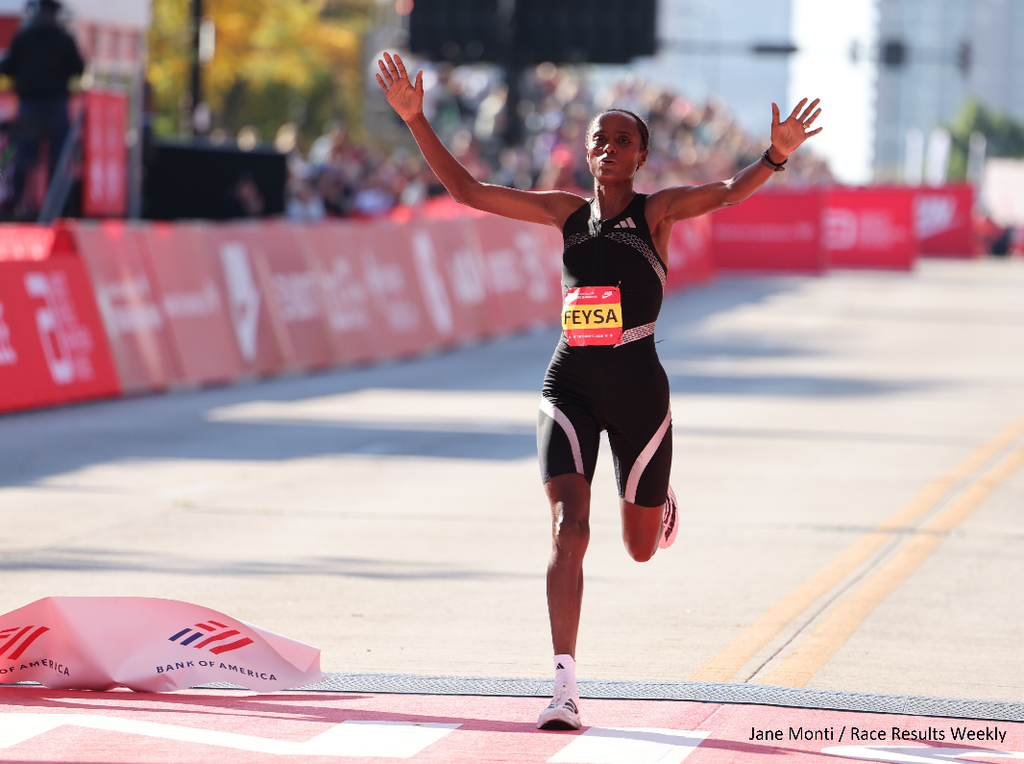
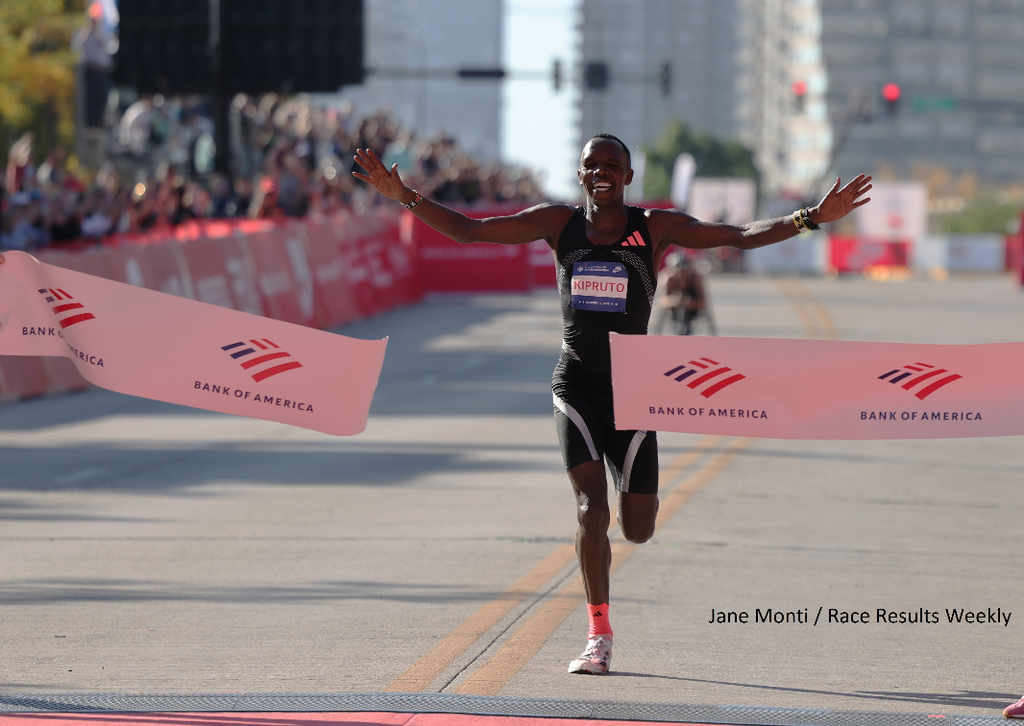
CHICAGO (11-Oct) — On a brilliantly sunny but humid day here, Hawi Feysa and Amos Kipruto stormed to victory at the 48th edition of the Bank of America Chicago Marathon this morning. Feysa, from Ethiopia, successfully defended her title from last year and clocked a personal best 2:13:33. Kipruto, from Kenya, who had finished third here in 2024 and second in 2025, finally finished first in a personal best 2:01:09. Both athletes won $100,000 in prize money.
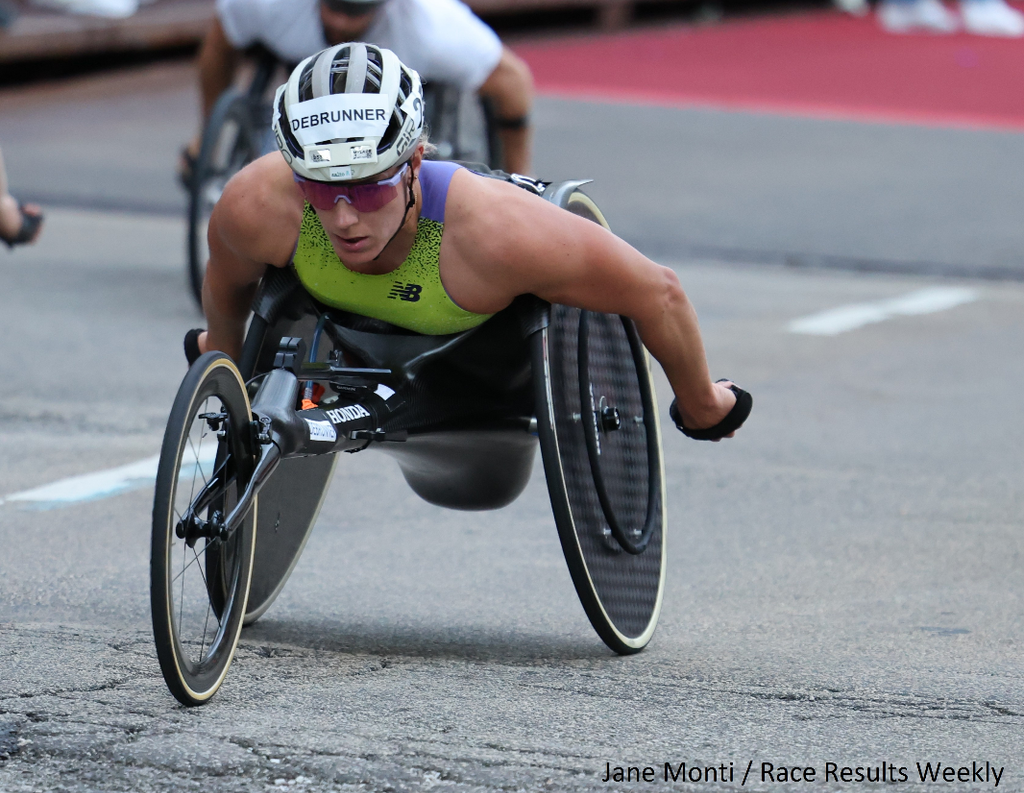
The wheelchair winners were Marcel Hug of Switzerland, who took his seventh Chicago title and broke his own course record. Catherine Debrunner, also of Switzerland, won the women’s race and smashed her own world record by a minute. Both of the wheelchair winners earned $90,000 in prize money and time bonuses.
MEN WERE AGGRESSIVE FROM THE START
Despite high humidity (82% at the start), the men went out at a hard pace right from the gun. Led by pacemakers Oscar Chelimo of Uganda, and Daniel Ebenyo and Gideon Rono of Kenya, a pack of six contenders hit 5-K in 14:18. Those men –Kipruto; Jacob Kiplimo of Uganda; Tadese Bikila, Milkesa Mengesha, and Boki Diriba of Ethiopia; and Daniel Mateiko of Kenya– were already eight seconds under the pace set by the late Kelvin Kiptum, who set the course record of 2:00:35 in 2023.
“One thing about Chicago is you see the aggression right away,” said Olympian Kara Goucher, who was commentating on the race broadcast.
That group held together through 10-K (28:38), 15-K (42:56), 20-K (57:13), and halfway (1:00:21). But over the next five kilometers, both Mengesha and Diriba fell back. The pace dropped (14:06 from 20 to 25-K), and the stage was set for the real action to come. Kiplimo, the race’s defending champion, put in a surge and Mateiko and Bikila were dropped.
“The marathon begins at 30 kilometers,” Kipruto said later. “Today I tried my best.”
Just before 35-K, Kipruto dropped Kiplimo. The Kenyan ran 4:33 for the 22nd mile, and 4:40 for the 23rd. That put the race away.
“I was here to fight,” said Kipruto, who told reporters that he added more mileage to his program after his fourth place finish at the TCS London Marathon last April. “I think that the preparation for me was perfect.”
Kiplimo, who looked unstoppable at last year’s race here, struggled in the final kilometers. By 40-K he had dropped to third place, and was only fourth at the finish in 2:04:18. Bikila (2:02:56) and Mengesha (2:03:46) took second and third, respectively.
Not too far behind the leaders, a fascinating battle played out among the top American men. Vinny Mauri, who ran a USA debut record of 2:05:55 at the Mercy Health Glass City Marathon in Toledo last April, pulled away from his domestic rivals at 15-K, and by the halfway mark he was on 2:04:30 pace That put him on track to break Conner Mantz’s American record of 2:04:43 set here last year, although he said later that he was trying to run even faster.
“I think it was a really interesting dynamic where you had a whole range of aggression with the top three Americans running together trying to catch Vinny Mauri,” said Charles Hicks who, along with Clayton Young and Japan’s Akira Akasaki, were trying to catch Mauri.
Mauri, running with a backwards baseball cap, looked invincible. But just before 35-K the 25 year-old suddenly stopped. He bent forward trying to stretch his hamstrings. Hicks saw what was happening ahead of him and was confused.
“I actually thought he was showboating,” Hicks said of Mauri. He added: “I didn’t know if that was a taunt or if his hamstring was really bothering him.”
Mauri, who did the bulk of his training on a treadmill, would stop two more times to stretch and end up finishing tenth in 2:06:45. Young, a 2024 Olympian who revealed before the race that he had a 12 centimeter hamstring tear, surged away from Hicks with a 4:47 24th mile and finished as the top American in 2:05:23 (Hicks was eighth in 2:05:35). That was good for seventh place, but Young fell short of breaking Mantz’s national record, a goal he had announced before the race.
“I’ve been transparent this whole build,” Young told the media. “Even on the start line I was like, let’s take it a mile at a time.”
Not part of the tussle among the leading Americans, two-time Olympic medalist Galen Rupp also had a sensational race. The 40 year-old smashed the national masters (40+) record by over three minutes with his 2:06:55 clocking. He finished 11th and was the fourth American. The last time he ran under 2:07 was here in Chicago five years ago when he finished second. In 2024 he had hip surgery, and credited his coach Mike Smith for helping him to reach a high level again.
“Healthy always has to be the top priority,” said Rupp. “Mike has been such a blessing, talking me through different things and helping me see training in a different light.” He continued: “He has always met me where I’m at.”
FEYSA SURVIVES FAST EARLY PACE
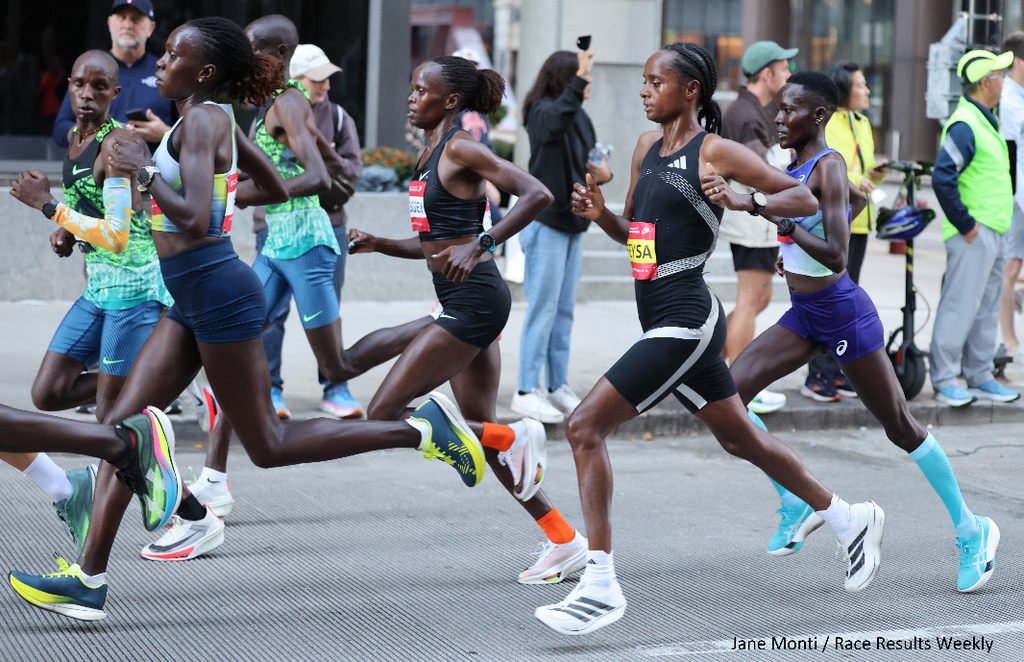
The women were equally aggressive today. Feysa, accompanied by two-time Chicago champion Brigid Kosgei of Kenya, tore through the first 10-K in 31:04. That pace was a little too hot for the other top women, and a pack of four Kenyans –Joan Kilimo, Sharon Lokedi, Brillian Kipkoech, and Loice Chemnung– chose to run a few seconds behind.
But by 20-K Lokedi and Chemnung caught the leaders and the four women went through halfway in 1:06:06. That quartet stayed together through 25-K (1:18:26), but in the next 5-kilometer segment the best athletes showed their cards. Feysa and Lokedi ran 15:50 from 25 to 30-K taking both Kosgei and Chemnung out of contention (Kosgei would finish third in 2:14:55 and Chemnung would fade to tenth in 2:21:18). Feysa was ready for anything.
“It’s true it was a very hard-fought battle,” Feysa said through an interpreter. “At around 35-K I knew I was going to win.”
Feysa and Lokedi traded surges, and seemed to be battling to a stalemate.
“It is like a good boxing card,” said Olympian Ed Eyestone on the race broadcast.
But with the race clock showing 2:10, Feysa put in a mighty surge that Lokedi could not answer. With a mile to go the two women were still running together, but by the finish line in Grant Park Feysa had put 34 seconds on Lokedi. The Ethiopian immediately fell to her knees after breaking the finish tape and had to be helped up by one of the race staff.
“It was an interesting back and forth there,” she said of her battle with Lokedi, a two-time Boston Marathon champion.
Lokedi was timed in 2:14:07, a personal best by more than three minutes. Another Kenyan, Mary Ngugi-Cooper, took fourth in 2:17:23, and Kilimo got fifth in 2:18:39.
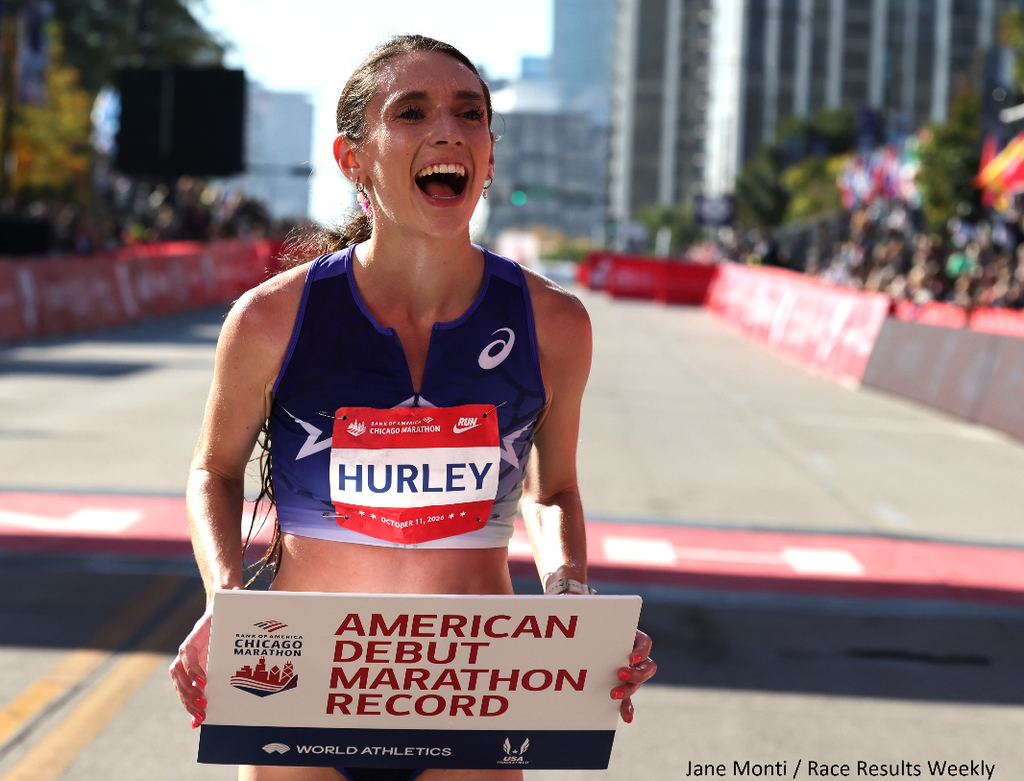
Finishing sixth and seventh, respectively, Isobel Batt-Doyle of Australia and Emma Grace Hurley of the United States both had excellent races. Batt-Doyle set a new Australian record of 2:20:38 (previous 2:21:24), and Hurley ran an American debut record of 2:20:47. Hurley moved from 13th place at 10-K, to tenth at halfway, to seventh at the finish. Completely spent, she threw-up immediately after finishing.
“I felt really good through 20 (miles), then I got a little hot and started really feeling it around 22,” Hurley told reporters. “But fortunately for me, there were still women to chase, so I just had the best time. I had fun the whole time.”
Minnesota Distance Elite teammates Dakotah Popehn and Elena Hayday were the second and third Americans, finishing 12th and 13th in 2:24:00 and 2:24:57, respectively. Popehn set a personal best. Susanna Sullivan, who was fourth at last September’s World Championships marathon, dropped out before 20-K.
WHEELCHAIR RACERS SET RECORDS
The weather conditions were better for the wheelchair racers than the runners, and both Hug and Debrunner took full advantage. Both athletes surged clear of their rivals very early on the race, and time-trialed to their wins. Hug’s time of 1:21:34 was 63 seconds faster than his course record, and organizers will pay him a $50,000 course record bonus on top of his $40,000 first place prize.
“I felt really amazing today,” said the soft-spoken Hug. “Weather conditions were perfect for us in the wheelchairs.” He added: “I’d say today was one of the best performances in my career.”
Debrunner’s performance was simply overwhelming. By halfway (45:42) she led by more than four minutes, and that gap mushroomed to eight minutes and 45 seconds by the finish over runner-up Tatyana McFadden. Her world record time of 1:33:16 was a full minute faster than the previous record. Like Hug she’ll receive $40,000 in prize money plus a $50,000 course record bonus.
“Actually it was very unreal,” Debrunner said of her performance today. “I can’t believe I did the world record in Chicago.” She added: “I’m super-happy. It’s unbelievable.”
PHOTO: Amos Kipruto of Kenya winning the 2026 Bank of America Chicago Marathon (photo by Jane Monti for Race Results Weekly)
PHOTO: Hawi Feysa of Ethiopia winning the 2026 Bank of America Chicago Marathon (photo by Jane Monti for Race Results Weekly)
PHOTO: Emma Grace Hurley after setting a USA debut marathon record of 2:20:47 at the Bank of America Chicago Marathon (photo by Jane Monti for Race Results Weekly)
PHOTO: Catherine Debrunner of Switzerland on her way to a world record at the 2026 Bank of America Chicago Marathon (photo by Jane Monti for Race Results Weekly)
PHOTO: The women’s leaders just past the halfway point at the 2026 Bank of America Chicago Marathon (photo by Jane Monti for Race Results Weekly)
ENDS
Debrunner_Chicago_Mile_3__CROP_2026_Jane_Monti_With_Credit.jpg
Feysa__Chicago_Finish_Tape_Break_Arms_Raised__CROP_2026_Jane_Monti_With_Credit.jpg
Hurley_Chicago_American_Debut_Record_Sign_EDIT_2026_Jane_Monti_With_Credit.jpg
Kipruto_Amos_Chicago_Finish_Pre_Finish__#2_CROP_2026__Jane_Monti_With_Credit.jpg
Feysa__Chicago_Mile_13__Side_View_EDIT_2026_Jane_Monti .jpg